Latest Entries »

Happy Birthday to Henri Dunant! Today marks what would have been the 184th birthday of the founder of the International Red Cross and Red Crescent Movement, the man who conceived of what would become the Geneva Conventions, and the recipient of the first Nobel Peace Prize. The American Red Cross, along with other national societies, continues to spread the same humanitarian ideals touted by Dunant over 150 years ago, in part through dissemination of international humanitarian law (IHL). I have been proud to be an IHL instructor for the American Red Cross for more than 4 years now, and now Chair the International Services Committee at my local Southeast Louisiana Chapter in New Orleans.
Today, the Presidents of ICRC and IFRC issued a joint statement reminding us how vital young people are to the International Red Cross and Red Crescent Movement, saying “we must work to better recognize, invest in and empower the next generation of young leaders who will surely carry our Movement and our lifesaving mandate forward. Today, we recognize “Youth on the move,” and the profound impact that young people, who represent nearly half of our volunteers world-wide, are having in their communities and on the global stage through the Red Cross and Red Crescent.”
In addition, the ICRC Regional Delegation for the US and Canada reminds us that this month’s operational focus is on violence and displacement of civilians in Colombia, which not only continues but grew in volume in 2011. I have studied the problem of IDPs in Colombia as a result of the continuing violence, which has lasted 50+ years – the “desterrados” are the forgotten displaced, an IDP crisis happening in the Americas. When people think of displacement, they think of IDPs and refugees fleeing from conflict across Africa, but Colombia is often forgotten. Take a look at the ongoing efforts of ICRC and this violence than has been raging for more than half a century, right here in our own hemisphere.

The Red Cross is an organization that has always been close to my heart – I’ve been a Red Crosser for 11+ years, and continue to work hard to support the organization and live up to it’s reputation. My involvement with the American Red Cross has spanned 3 chapters and include a laundry list of functions, including: youth manager, disaster instructor trainer, shelter manager, CPR/First Aid instructor, IHL instructor, DAT member, logistics officer, babysitting instructor, grant writer, fundraiser, event planner, leadership development center director, IS committee chair, caseworker, and many more! I’m proud to share my birthday with World Red Cross Red Crescent Day and with Henri Dunant – I take it as evidence that I belong with the organization and will continue to call it my home.
We distributed eyeglasses to nearly 1,100 people and completed 40-something surgeries in Chinandega, last week, as part of this year’s New Orleans Medical Mission Services trip to Nicaragua. The week before, another NOMMS team in Matagalpa saw over 1,450 patients in the eye clinic and 43 surgeries. Overall, a successul time in Nicaragua this year.

For me, the trip was particularly fulfilling, as I had the opportunity to serve as director of the eye clinic in Chinandega. This being only my 2nd mission with NOMMS, I was a bit nervous, especially since my Spanish is pretty rusty – I can’t conjugate worth a damn, so everything is happening right now, nothing has ever happened or will ever happen when I’m speaking Spanish! But my team in the eye clinic was great, including the fabulous Dr. Frank Romano, who really brought an extra dimension to the clinic with his insights into reading the prescription slips (papelitas) and identifying solutions to help people see better that weren’t easy to discern from the auto-refractor readings alone. Our operation was one of quality over quantity, seeing fewer patients than other trips, but I feel really confident and pleased with the work we did in spending more time with each patient to make sure we were getting the right fit for each of them. That’s what’s important, and combined with the fact that we didn’t turn anyone away – all the demand was met, everyone who came to the clinic got in and was seen – leaves me more than satisfied with the week’s efforts.

Of course, as a student of development, I continue to think about the sustainability factor – NOMMS is really doing good work and I believe in the organization, but I will be promoting activities with them more focused on capacity-building in the countries we’re visiting and based more in education for the local doctors and nurses we’re working with. As with any humanitarian effort, we should be trying to work ourselves out of a job. Modifying the focus of the missions to include a larger component of training and capacity building, in my opinion, should be the future focus of the organization so I will bring these ideas to the board and see what we can do to make that a priority.

In the meantime, our partners in Nicaragua are fantastic. Hospital España and Hospital Mauricio Abdala were gracious and helpful hosts, and the Coen Foundation took great care of us, helping to get all of the arrangements settled in advance and providing us with a lovely reception the final day of the trip. Our volunteers were fantastic, the folks in the eye clinic (Eric, Maureen, Suzanne, Lois, & Mary) were troopers, working 11-hour days and with endless patience. I am looking forward to my next experience on a NOMMS mission, hoping to get further into the logistics side of the operation.

For more info on NOMMS:

Introduction

As part of my participation in the TechChange Course “New Technologies for Educational Practice”, I conducted an interview with Deborah Elzie at Tulane University’s Disaster Resilience Leadership Academy (DRLA).

Mini Biography

Deborah Elzie is an Instructional Designer with the DRLA at Tulane University’s Payson Center for International Development. Deborah’s education consists of an M.A., Educational Psychology from Columbia University, and M.Ed., Educational Technology from Southeastern Louisiana University. She has expertise in developing, designing and supporting academic institutions in East Africa in the area of distance and eLearning specifically related to health and disaster management. She has experience designing curriculum and training faculty and staff on ways of using blended learning, ICTs, and new media for enhancing teaching and learning. Deb is currently based in Kampala, Uganda working closely with Makerere University’s School of Public Health. Deb is one of the co-founders of The Kuyu Project and StorySpaces. Additionally, she is part of a team of mobile and web programmers working primarily in Uganda. She’s also involved with Africa Women in Tech.

Interview Notes

I spoke with Deborah today (Thursday, April 12, 2012) about the technologies we’ve encountered in the TC106 course, her views on some of them, and her experiences using technology for education in a variety of settings. Deborah’s work focuses on enhancing teaching and learning using ICTs and new media. Here are some of Deborah’s (paraphrased) comments on the field, the merits and pitfalls of some of these technologies, and utilizing them in a development context.

View full article »

I was recently selected as a new member of the Executive Leadership Committee for Evacuteer.org, and organization that helps New Orleans to implement the City Assisted Evacuation Plan in the event of a disaster that requires residents of the city to leave town. Evacuteer has been inspiring and engaging volunteers in New Orleans, mostly young professionals and students, since after Hurricane Gustav, and we have a strong partnership and a great deal of support from the City itself. I’ll be active with the Operations Team, responsible for helping recruit and train our Evacuteers, engage and sign MOUs with our community partners, and refine our Operations Plan so that we can better respond when needed and be sure our whole team is prepared to assist in the event of a disaster. This is a natural extension of my background in disaster response with the American Red Cross (no, I’m not leaving the Red Cross, this will be in addition to my volunteer work with them), and my coursework in humanitarian aid and disaster resilience, particularly with the Disaster Resilience Leadership Academy. I’m looking forward to an exciting and productive year with Evacuteer.org!

Opposing SOPA & PIPA

I didn’t become aware of the issues surrounding the bills known as SOPA and PIPA (aka PROTECT IP) until a couple of days ago, and, like any bill, each of them is complex and difficult to understand, with legalese language and sometimes vague and ambiguous statements. One thing that is clear from reading parts of them is that they don’t seem to have been written by folks who know how the Internet actually operates in 2012.

SOPA (bill H.R. 3261) and PIPA (bill S.968) pose a serious threat to Internet freedom and threaten any site with user-generated content, which means sites like Wikipedia, YouTube, Tumblr, and just about any social media or blog site are in danger of either having to shut down, face federal charges, or take on an overwhelming amount of responsibility in policing their content to avoid liability which would likely be too cumbersome for their existing capacity.

I am not an expert and I still don’t understand all the implications and details, but I have read enough of the bills and commentary on them from trusted sources to know that I don’t want these bills to pass. Today, in protest of these bills, several big-name sites are protesting, many of them shutting down entirely, to spread awareness to their users about the dangers posed by these bills. These sites include Wikipedia, Google, Tumblr, Reddit, and more. (see a full list at Mashable) Even the LOLcats are in, and if that doesn’t convince you, I don’t know what will.

The end goal of the bills is ostensibly to limit piracy online, which is a completely reasonable thing to attempt. But SOPA and PROTECT IP are not the answer.

Recommended Reading on SOPA and PROTECT IP: 

Today marks the second anniversary of the devastating earthquake that hit the impoverished nation of Haiti on January 12, 2010. Thousands of responders and long-term recovery workers have been toiling to save lives and help rebuild and recover over the past 24 months, but there’s no denying the frustrating notion that two years later there still seems to be so little “real” progress. Here, a brief roundup of triumphs and ongoing trials of the earthquake relief and recovery operations, and the state of the nation 2 years since the disaster:

Bertha Henry, 17, lives in La Piste camp with her family. Photo Credit: Julien GOLDSTEIN/IFRC

News Articles

The Guardian: Two years on, and just half of promised aid has been delivered.

Reuters AlertNet: Haiti to mark two years after catastrophic quake.

PBS Photo Spread: Haiti, two years on.

Huffington Post: Haiti Earthquake Recovery: Where did all the money go? (Infographic)

Agency & Organization Reports

Tulane University Disaster Resilience Leadership Academy Haiti Humanitarian Aid Evaluation Database

American Red Cross: Haiti Earthquake Response, Two-Year Update.

UNICEF Report on victories & challenges for children. Press release and full report.

Plan International Haiti: Two Years After: Successes, Challenges, and Priorities.

UNOCHA Press Release: Two years after the devastating earthquake.

Oxfam Haiti Progress Report: January – December 2011.

Blogs, Videos, Media

IFRC Media Blog: Two Years On, ongoing work of Red Cross Red Crescent.

Dochasnetwork’s Blog: Haiti two-year summary.

American Red Cross video: Haiti, two years on.

Introduction

As part of my participation in the TechChange Course “Mobiles for International Development”, I conducted an interview with professor Laura Murphy at Tulane University’s School of Public Health & Tropical Medicine and Payson Center for International Development.

Mini Biography

Laura Murphy is clinical associate professor in the Department of Global Health Systems and Development at Tulane’s School of Public Health and Tropical Medicine (SPHTM). Her teaching spans development, population, environment, and interdisciplinary social science research, and in 2008 she earned the President’s Award for Excellence in Professional and Graduate Teaching. She is also an adjunct associate professor at Tulane’s Payson Center for International Development and an affiliated faculty member at Tulane’s Stone Center for Latin American Studies. She holds a BS from Stanford in Mechanical Engineering, Values, Technology & Society, and a doctorate from UNC-Chapel Hill in City & Regional Planning.

Interview Notes

I spoke with Dr. Murphy today (Monday, November 21, 2011) about the technologies we’ve encountered in the TC105 course, her views on some of them, and where she sees the future of the field going. Dr. Murphy’s work focuses on social change in rural Africa and the HIV/AIDS epidemic in that region, as well as mobile phone use in the region. Here are some of Dr. Murphy’s (paraphrased) comments on the field, the merits and pitfalls of some of these technologies, and her vision for the future.

View full article »

Introduction

As part of my participation in the TechChange Course “Tech Tools and Skills for Emergency Management”, I conducted an interview with colleague Adam Papendieck at Tulane University’s Disaster Resilience Leadership Academy. TechChange posted the interview on their own blog this morning, but I thought I would share it here as well.

Mini Biography

Adam Papendieck has an MPH from Tulane University and a technical background in GIS, Statistics and Information Systems.  He is currently the Sr. Program Manager for Technology at the Payson Center for International Development at Tulane University, where his role is to leverage appropriate and innovative information technologies in support of research projects, funded Public Health capacity-building projects in East Africa, and crisis informatics activities with the Disaster Resilience Leadership Academy.  He has worked on applied ICT activities such as the creation of a dynamic web mapping application for the World Vision US corporate information portal, the design and implementation of open source thin client computer labs in Rwanda, the creation of e-learning platforms at African institutions of higher education, various crisis mapping initiatives and disaster analytics activities for the Gulf Oil Spill, Hurricane Katrina and other events.

Interview Notes

I spoke with Adam today (Monday, September 26, 2011) about the technologies we’ve encountered in the TC103 course, his views on some of them, and where he sees the future of the field going. Adam is particularly interested in crowdsourcing and has experience working with Ushahidi, both on the development/applied side for the Gulf Oil Spill last year, and on the evaluation side following the earthquake in Haiti. Here are some of Adam’s (paraphrased) comments on the field, the merits and pitfalls of some of these technologies, and his vision for the future:

View full article »

I’m pleased and excited to announce the first major project of the Ports in the Storm blog: a study of Qualitative Data-Gathering Methods of Major International Humanitarian Organizations. This study began as an independent study course for the summer of 2011, designed to be an exploration of the dominant qualitative data-gathering methods most often employed by the major international humanitarian aid organizations, under the supervision of Payson Adjunct Assistant Professor Nathan Morrow.

This study has grown into a larger and more exciting project than originally anticipated, and as such I have created a series of resources based on my findings, including an index of sources, a series compilations of methodology and utilization of a variety of qualitative methods, a discussion of prescribed methods vs. methods employed by the organizations studied, some best practices, gap analysis, and proposal for the minimum tools and training to be employed in each phase of the humanitarian program cycle.

These elements are set up as a series of blog posts from the past couple of weeks, and are all accessible via the page on this blog entitled “Qualitative Data-Gathering Methods of Major International Humanitarian Organizations“.

It is my sincere hope that this study and the resources complied therein will be useful for others in the field of international development and humanitarian aid studies, as a resource of best practices in qualitative research. I welcome and look forward to feedback – please let me know what you think and feel free to provide suggestions for additional resources and/or research!

DISCUSSION

Availability of Resources & Reports

A fundamental difficulty with this study is that it relies on the toolkits, guidelines, reports and other documents publicly accessible from the organization websites. This introduces the very real possibility (indeed, likelihood) that these documents are not a representative sample of the work being done by these organizations. However, one could reasonably assume that the documents publicly accessible (and therefore included in this study) were selected to be posted online based on their quality, their relevance to current humanitarian crises, or their treatment of current issues in humanitarian aid, and are therefore worthy of consideration here.

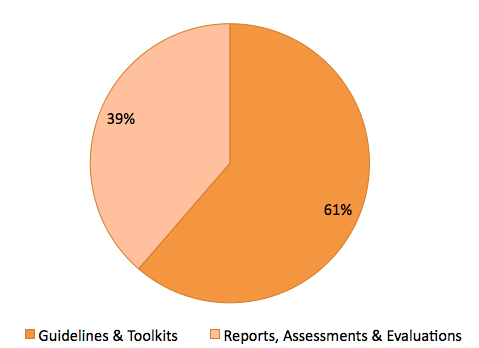
Two types of documents were sought for inclusion in this study: (see Chart 1)

  1. Documents such as guidelines or toolkits which outline prescribed practices to be used in the field when carrying out a particular stage of the program cycle; and
  2. reports, such as assessments, appraisals, or evaluations of actual aid responses or programs carried out by the organization.

Chart 1: Documents Reviewed by Type

View full article »